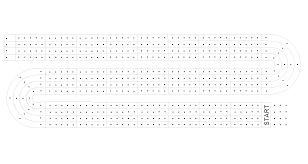
A cribbage board is one of the few game tools that teaches the game while you use it. You don’t just keep score—you watch the hand’s momentum, the swings, the slow crawl toward the last holes. That tactile rhythm is exactly why people search for a cribbage board template: they want a layout that feels natural to peg, easy to count, and hard to mess up.
Know what you’re actually templating
Most boards are designed for games to 121 points, the common target score.
The classic layout usually gives each player a track that effectively covers 120 scoring holes, plus a finish/“game” point concept that completes the 121-point journey. Different boards handle the start and finish holes slightly differently, but the intent is the same: a clear path from 0 to 121.
Traditional boards often organize the journey into four “streets” of 30 points (1–30, 31–60, 61–90, 91–120), because it’s easier to count and visually sanity-check.
Cribbage is also a quiet champion of 2 player card games—fast, social, and just competitive enough to make the pegs feel personal.
Choose a board style before you draw a single hole
A template gets simpler when you pick a form factor upfront. Three common styles cover almost every DIY build:
The classic rectangle (two tracks, back-and-forth)
This is the familiar wooden board shape—often around 250–300 mm long and 70–80 mm wide.
The tracks typically run “out” and “back” in blocks of 30, so pegging has a clean rhythm and the counting lines up with groups of five.
The continuous track (paperclip-style)
Instead of out-and-back lanes, the holes form a continuous loop. It’s visually modern, very readable, and great for compact templates—especially if you want a printable pattern to glue onto wood before drilling.
The travel board (compact and minimal)
A smaller footprint can still be accurate, but it demands more care in spacing and hole alignment so pegs don’t collide.
Peg and hole sizing: the template must match real hardware
Before layout, decide the hole diameter—because it controls everything else.
Many standard cribbage boards use 1/8 inch holes, which is about 3.2 mm in metric. Some oversized boards use larger holes (e.g., 3/16 inch ≈ 4.8 mm), but 3.2 mm is a common baseline.
Practical template rule:
-
Set your hole diameter first.
-
Then give yourself enough spacing so pegs don’t rub and fingers can lift them comfortably (especially if you’re using metal pegs).
The “groups of five” rule that prevents counting errors
Conventionally, cribbage holes are grouped in sets of five to make pegging and counting effortless.
When you design your template, bake those groups into the geometry:
-
Add a slightly wider visual gap every 5 holes, or
-
Mark every 5th hole location with a subtle dot/line on the template, or
-
Use a gentle curve or bend at each 5-count segment (works well on continuous-track designs)
This matters more than decoration. It’s the difference between “smooth to use” and “why do we keep losing track?”
Where the skunk line goes (and why people care)
Many boards highlight a “skunk line” around 90 points, because finishing 121 while your opponent is below 91 is a common milestone in cribbage culture.
Your template doesn’t need a skunk mark, but adding one small symbol between the 90th and 91st holes makes the board feel instantly familiar.
A simple way to design the layout (print-first, drill-second)
If you want the cleanest build process, design the template like you’re designing a drilling guide:
-
Draw the track path (two tracks or one continuous loop).
-
Place 120 hole centers per track along that path.
-
Add start/finish markers (even just “S” and “F” on the template).
-
Mark the 5-hole groupings and the 30-point street transitions.
-
Print at 100% scale (A4 works fine; tile across pages if needed), tape the pages together, then mount the paper onto the board blank for drilling.
This workflow is popular because it avoids the slow pain of measuring hole positions directly on wood. You measure once—in your design file—then you drill with confidence.
Materials and accuracy: what matters, what doesn’t
You don’t need perfection. You need consistency.
-
Hole diameter consistency matters (pegs should fit the same everywhere).
-
Track clarity matters (players should instantly understand the direction).
-
Decorative engraving is optional; readable geometry beats fancy styling every time.
If you’re in a humid environment (hello, Jakarta rainy season), wood movement is real. Sealing the board helps keep holes clean and prevents swelling around tight pegs.
One small human insight that makes boards feel “right”
People don’t peg in a straight line—they peg in a rhythm: leapfrog, confirm, relax. A board that’s too cramped forces awkward fingers and breaks that rhythm. So when you build your template, design for hands, not just for points. The best boards feel invisible: nobody talks about the board, because it never gets in the way.
A good template isn’t just a pattern of dots—it’s a scoring experience. If you lock in a 121-point journey, group holes in fives, pick a realistic hole diameter (often around 3.2 mm), and mark key milestones like the 90-point skunk line, your cribbage board template will look classic and play even better.